

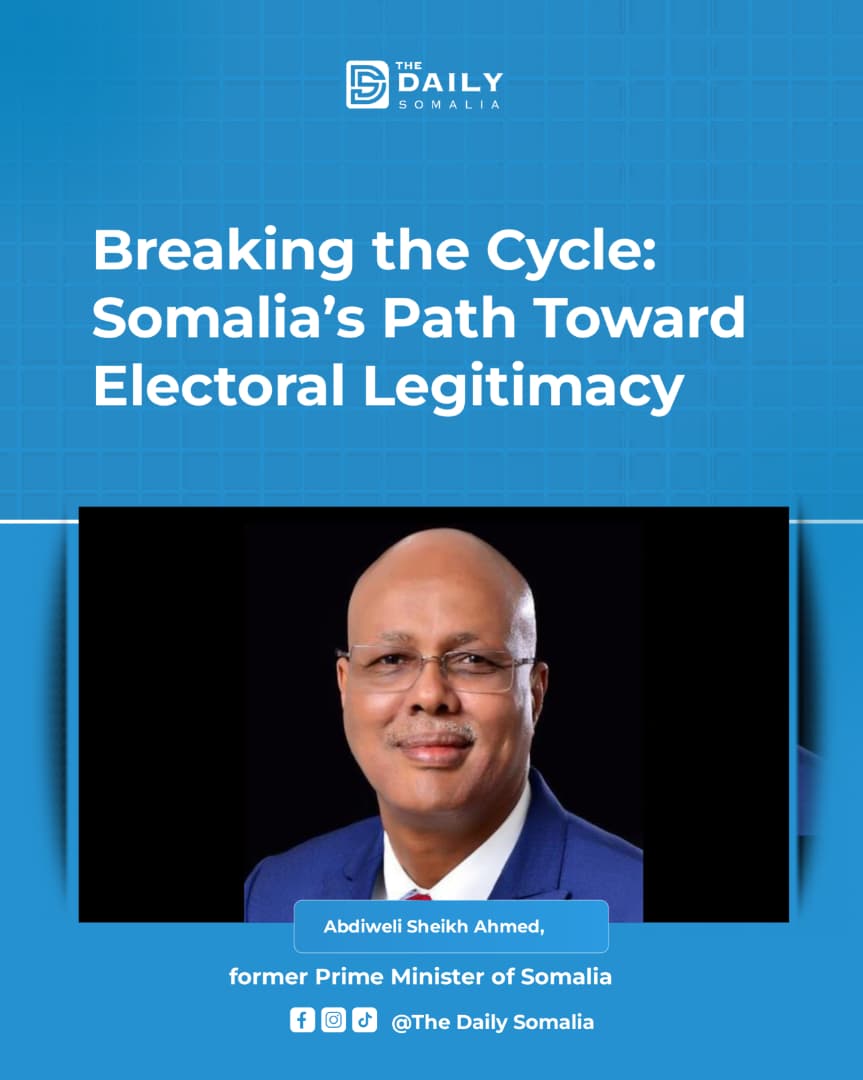
Why Somalia Needs a Caretaker Government
By Abdiweli Sheikh Ahmed, the former Prime Minister of Somalia
The cycle of term extensions that has characterised Somali politics since 2012 has not resolved crises but rather has exacerbated them. It has led to the erosion of legitimacy, deepened divisions and pushed a meaningful and lasting political settlement further out of reach. There is no basis for the illegal extension of the current administration’s tenure, especially when that same administration looks to manage the 2026 electoral process.
Caretaker governments are temporary arrangements designed to address one or more issues that include: (i) mistrust; (ii) the need for greater transparency; and (iii) the need to check the power of an outgoing government to level the playing field for political actors. All of these conditions are present today in Somalia ahead of the 2026 elections.
The international community’s repeated intervention to mediate Somali electoral disputes signals to the world that Somalia cannot self-govern, the very perception that undermines our sovereignty. A homegrown caretaker government arrangement, developed by Somalis and accountable to Somalis, offers an opportunity to break this cycle. This is a Somali solution for Somali problems – one that draws on international best practice but adapts it to our context.
Introduction
Somalia is at an inflection point in its modern history.
The scheduled end of the term of the Hassan Sheikh Mohamud administration on May 15, 2026, alongside heightened tensions in the region, largely owing to Israel’s recent recognition of Somaliland, makes the upcoming electoral transition the most consequential in Somalia’s post-civil war history.
Somalia faces both internal and external threats to its sovereignty. The external challenges include Israel’s recent recognition of Somaliland, the effective end of the post-World War II global order that guaranteed the protection of the sovereignty and territorial integrity of states, and the Red Sea Crisis, which has elevated the Horn of Africa’s strategic significance. There are also internal challenges from patterns of electoral crises and dysfunction that have characterised every Somali election since 2012 alongside internal political divisions. No transition has happened without serious controversies, irregularities, delays, and concerns regarding legitimacy. The unilateral constitutional amendments in addition to the recent attempts to make additional amendments by the current administration have further eroded confidence and raised serious questions about the legitimacy of the constitution itself.
As I’ve made the case in my op-ed on WardheerNews, the way in which Somali political actors manage the 2026 electoral transition will send a clear message to the world on whether the Somali people can govern themselves.
This is a vicious cycle. A lack of electoral legitimacy begets challenges to our sovereignty. Somalia’s electoral legitimacy is the shield behind which we defend our sovereignty and territorial integrity. Somalia’s political class must demonstrate the political maturity and social cohesion to protect its sovereignty in an increasingly hostile international environment.
This proposal presents new alternatives to create a virtuous circle in which neutral electoral management produces a credible outcome that signals to the world that the Somali people can govern themselves, that their sovereignty is inviolable, and that their divisions cannot be exploited. The recommendations in the proposal are agnostic on the electoral model. The caretaker government’s mandate is not to determine how Somalis elect their leaders, but to neutrally implement whatever framework emerges from negotiations between the Federal Government, Federal Member States, and the opposition during the ongoing national dialogues.
We have chosen unity before
The Somali Youth League once galvanised a divided Somalia around a unifying idea: that Somalis belonged to a single political community and deserved sovereignty over our lands. This spirit must be revived, not as a nostalgic dream, but as a strategic necessity.
In my op-ed I invoked the Somali proverb: “waloolo coloobay, way xoolo yarayaan, wayna xabaalo badiyaan” – when brothers fight, they diminish their wealth and increase their graves. In essence, this proverb encapsulates the underlying truth of Somalia’s current situation, including the forthcoming elections: irreconcilable and intractable political divisions do not benefit Somalis, while external actors are eager to exploit those divisions.
The Reforms Somalia Needs
Those who care about the future of Somalia would be the first to highlight that reforms are needed to put an end to the existing patterns of electoral dysfunction, the constitutional and political crises and the evident shortcomings in how electoral transitions have been managed since 2012.
For far too long, incumbent governments have leveraged the state apparatus during elections to attempt to manipulate the process in their favour, casting serious doubt on the electoral legitimacy of the process.
Since 2012, Somalia’s various electoral transitions (2012, 2017, 2022) have entrusted incumbent political administrations with the responsibility of fairly managing the electoral process, yet these transitions have sowed the seeds of division and undermined electoral legitimacy. At this juncture when a lot is at stake for Somalia in terms of its sovereignty and unity, we must now entrust electoral management to neutral officials.
This proposal sets out the case for an election-time, non-political caretaker government to manage the 2026 electoral process. It aims to learn from international best practice for the establishment and operationalisation of caretaker governments from country contexts experiencing extreme divisions and mistrust, adapting them to Somalia’s context (a weak judiciary, unilateral constitutional amendments, and a fragmented opposition).
Summary of Recommendations
The first set of recommendations aims to establish the political foundations for a caretaker arrangement. The aim is to ensure that Somalia’s electoral process is managed neutrally, to guarantee a transition that reflects genuine democratic will (as feasible in Somalia) rather than manipulation, and to uphold the sovereignty imperative that makes electoral legitimacy a matter of national survival.
Currently, none of these objectives are guaranteed by existing institutions. Hence, my first recommendations, therefore, seek to establish mechanisms for neutral management of the 2026 electoral process. The recommendations are:
1) A political compact that articulates the purpose of a caretaker government (to conduct credible elections that demonstrate Somalia’s capacity for self-governance and protect its sovereignty) should be signed by the Federal Government of Somalia (FGS), all Federal Member States (FMSs), major opposition figures, representatives of civil society, traditional authorities, and international guarantors.
2) An election-time, non-political caretaker government should derive its legitimacy from multiple sources, the Federal Government of Somalia, FMSs, traditional and religious leaders, civil society and international guarantors, rather than from any single compromised national institution.
3) To ensure neutrality and to prevent any temptation that may arise when using a position within the caretaker government to seek office, all members of the caretaker government should sign binding commitments or a “self-denying resolutions”, making them ineligible to contest elections or accept political appointments for a specified period. This should be accompanied with public oath-taking before traditional and religious leaders.
4) Provisions for a caretaker government should include a limited mandate principle, focusing on organizing elections and maintaining basic public services (particularly security). It should limit any actions that would: (i) alter the constitution, (ii) enter into new international agreements or (iii) make significant policy decisions.
The second set of recommendations is centered around establishing the structure and selection process for the caretaker government itself. The recommendations are:
1) A Nomination Committee comprising representatives from the FGS, FMS, traditional elders, religious leaders and civil society should develop criteria and vet candidates for the Head of the Caretaker Government .
2) The Head of the Caretaker Government should be a figure commanding broad respect across political lines, with demonstrated commitment to national unity, no active political ambitions, and acceptance of the self-denying resolution.
3) A Caretaker Council of Secretaries should cover essential portfolios. It should comprise professionals and technocrats selected with sensitivity to clan balance but prioritising capability.
4) The National Independent Electoral Commission (NIEC) should be strengthened immediately with the establishment of the caretaker government, with full autonomy, adequate resources, authority over all election-related personnel, and technical support from international partners.
5) International support to the caretaker government should be robust but advisory. The UN mission should provide an advisory role and there should be an AU election observer mission deployed.
The final set of recommendations address timelines and safeguards against mission creep by the caretaker government.
1) Time-bound deadlines with a fixed calendar end-date should be established with consequences for non-delivery. Depending on the electoral model agreed through the national dialogues, the caretaker government’s mandate should range from six to twelve months, but should in no circumstances extend beyond 12 months from the end of the term of the current administration (May 15, 2026).
2) International, regional and national monitoring of compliance with deadlines should be mandatory, with regular public reporting on progress.
Abdiweli Sheikh Ahmed,
The former Prime Minister of Somalia’s Federal Government


