

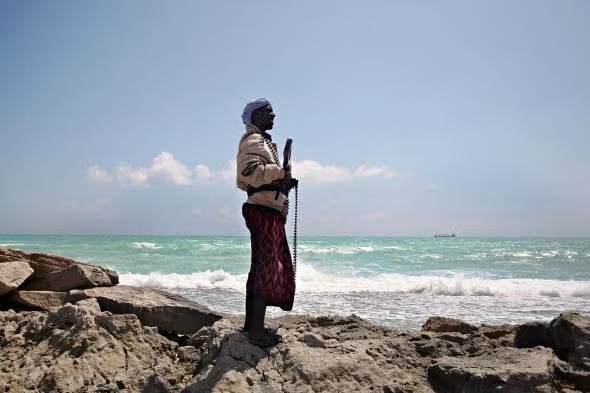
Somali piracy is often introduced as a story about criminals attacking ships from speedboats. That description captures the violence, but not the history. The phenomenon grew from state collapse, economic desperation, foreign exploitation of marine resources, weak maritime enforcement, and the opportunities created by a major shipping corridor that hosts roughly 20,000 vessels annually, carrying 12% of global seaborne trade. It was neither a simple popular uprising nor an inevitable product of Somali culture: it was a changing political economy that developed on land and at sea.
Before the Pirate Boom
Understanding Somali piracy requires distinguishing piracy from armed robbery, illegal fishing, maritime terrorism, and fishing-community conflicts under international law. While the Horn of Africa had a long maritime history, piracy was relatively uncommon before the modern Somali state was established. Coastal conflicts did exist, but they were not part of a continuous pirate tradition.
The decisive break came with the collapse of the Somali state in 1991. This collapse created a profound institutional vacuum: when a state loses the capacity to police territory, enforce contracts, and punish violence, authority does not disappear, it fragments. In this vacuum, local elders, militias, businessmen, smugglers, and armed entrepreneurs began to compete over who can provide protection and collect revenue. The first recorded incidents of modern piracy occurred almost immediately after the collapse, specifically between 1991 and 1994 along the northeastern coast of Puntland and the central Mudug region. Early reports confirmed that in the absence of a navy, foreign trawlers began harvesting an estimated $300 million worth of seafood illegally each year.
Somalia’s coastline became vulnerable not simply because the country was poor, but because no reliable institution could decide who had the right to fish, patrol, license vessels, or settle disputes. This vulnerability is best explained by political ecology, which connects environmental resources to power: fish stocks, coastal waters, and shipping lanes were not merely natural features, they were sources of wealth whose control changed after 1991. When foreign fishing fleets entered poorly regulated waters and local communities lost access to familiar livelihoods, environmental pressure became a political grievance.
The end of centralized authority weakened policing, courts, coastguard functions, licensing systems, and the ability to regulate foreign access to Somali waters. Coastal communities were left with few legal economic opportunities while foreign vessels could operate with limited oversight. The early emergence and local tolerance of piracy are deeply connected to statelessness, poverty, illegal fishing, and toxic-waste dumping. Political ecology does not excuse piracy, rather, it explains how resource depletion and unequal control can create the resentment and insecurity in which armed markets grow. UNEP reports from 2005 documented the washing up of rusted containers following the 2004 Tsunami, providing physical evidence of the toxic waste dumping that occurred during the 1990s.
This history describes piracy’s origins as a political-ecological sequence in which governance collapse and resource exploitation disrupted coastal livelihoods and increased maritime insecurity. This does not mean that every pirate began as a fisherman defending Somali waters. The collapse of governance changed incentives for several groups at once, some saw armed protection or attacks on foreign vessels as income, while others entered a profitable criminal market once ransom became available. Claims of defending Somali waters and the commercial reality of hostage-taking could coexist.
From Protection to Organized Crime
Somali piracy developed as a cycle with distinct politically connected phases, tracing its path from the early 1990s through the dramatic rise after 2006. This framework rejects the idea that piracy appeared suddenly in 2008. While the international community noticed the crisis most clearly after attacks on World Food Programme vessels, the underlying conditions had been developing for years. This evolution is supported by the opportunity theory of crime: organized crime requires a suitable target, weak protection, expected profits, and a reasonable chance of escape. Somalia’s location beside one of the world’s busiest shipping routes supplied those conditions, offering targets ranging from small dhows to Ultra Large Crude Carriers.
The transformation accelerated when hijacking ships for ransom became more profitable than opportunistic theft. Ransom transformed scattered maritime violence into a business, the target was valuable, the crew could be used as leverage, and the operation could be financed through networks onshore. World Bank data suggests that between 2005 and 2012, an estimated $339 million to $413 million was paid in total ransoms. As the business model matured, specific coastal towns evolved into specialized piracy hubs. Logistical nerve centers such as Eyl and Garacad in the north, alongside Hobyo and Harardhere in central Somalia, became the primary locations where hijacked vessels were anchored and negotiations were conducted. Between 2005 and 2011, attacks surged, peaking in 2011 with 176 reported attacks and 25 successful hijackings in a single year. Somali pirates became known for holding crews and cargoes hostage while negotiating their release. The operation required boats, weapons, fuel, intelligence, financiers, negotiators, safe houses, and intermediaries.
Finally, the idea of social legitimacy helps explain why some coastal communities in these hubs tolerated pirates. A group can be criminal in international law while presenting itself locally as a protector, employer, or defender against foreign exploitation. That claim may be selective or fraudulent, but it can still create cooperation, silence, or access to supplies. Somali piracy therefore combined coercion with persuasion, its strength came not only from guns and boats, but also from the ability of pirate groups to embed themselves in local economies. In some hubs, the piracy economy was so integrated that local shops provided credit to pirate crews, to be repaid doubled (Dheef-Koror) only after a successful ransom was collected. Piracy economies are dynamic, actors, tactics, and incentives change, and a wide network of participants joined as the activities expanded following the collapse of the formal economy. Illegal fishing, piracy, counter-piracy, fraudulent negotiators, and foreign and local intermediaries all became deeply entangled.
Why the Coast Mattered
The relationship between piracy and fishing was never simple. Somali communities had legitimate grievances about foreign fishing and the loss of control over marine resources. Yet local actors also committed predation, competed over fishing rents, and sometimes cooperated with smugglers, officials, or pirate networks. Naval presence eventually contributed to a decline in piracy, but coastal engagement was deeper than many accounts assume. The maritime predatory trap cannot be broken without treating former pirate communities as partners in a legitimate blue economy. Regional evidence shows that illegal and foreign fishing, weak governance, restricted access to fishing grounds, and criminal activity were major drivers. Conflict was particularly concentrated in Kenyan and Somali waters and the southern Red Sea, meaning piracy belonged to a larger maritime-governance crisis that cost the global economy an estimated $7 billion to $12 billion annually at its height.
Why Piracy Declined
The dramatic decline in attacks after 2011 resulted from a combination of international naval patrols, improved coordination, ship protection, and, crucially, a shift in local political and social conditions. While effective naval measures reduced piracy in the Gulf of Aden, they often displaced activity further into the Indian Ocean. By 2012, over 30 nations had deployed more than 40 warships to the region, creating the most intensive naval cooperation since World War II.
A decisive factor in this shift was the emergence of local Somali security actors, most notably the Puntland Maritime Police Force (PMPF). Established in 2010 with support from the United Arab Emirates, the PMPF became the only local force capable of conducting sustained counter-piracy operations on land. With a force that eventually grew to over 500 trained personnel, the PMPF targeted pirate logistics and blocked access to traditional anchorages in hubs like Eyl and Garacad. The presence of the PMPF allowed the Puntland government to assert control over the coastline, preventing criminal networks from returning to the same bays to dock hijacked vessels.
Equally important was a community-led social movement driven by traditional Somali leaders. Under the administration of Puntland President Abdirahman Farole, a community-centered approach was adopted to strip piracy of its social legitimacy. Religious sheikhs were mobilized to issue fatwas declaring piracy as forbidden (haram), while clan elders were encouraged to dissuade young men from joining pirate gangs. In Eyl and Garacad, once the world’s most notorious pirate capital, the local community eventually turned on the pirates, physically chasing them out of the town in 2011.
However, the decline should not be confused with the resolution of piracy’s root causes. Counter-piracy measures addressed only the symptoms of the crisis, such as maritime insecurity and weak law enforcement, while leaving triggers like corruption and economic dislocation intact. Traditional income-sharing arrangements helped contain conflict in some regions, but Puntland remained more vulnerable due to its proximity to deep-water shipping lanes and the survival of underground criminal infrastructures. This regional evidence suggests that while the PMPF and community leaders successfully suppressed the era of high-seas piracy, they did so within a fragile land-sea political economy that remained susceptible to future collapse.
The Unfinished Story
The most recent sources argue that Somali piracy is dormant rather than extinguished. A 2026 perspective links renewed risk to unresolved governance failures, illegal fishing, environmental degradation, and the survival of criminal networks. The resurgence began showing early signs with the hijacking of the MV Ruen in late 2023, the first successful capture of a merchant vessel in over six years. A major catalyst for this renewed activity was the shifting security landscape on land, specifically the withdrawal of the Puntland Maritime Police Force (PMPF) from the strategic Mudug and Garacad shoreline to address insurgency in the Bari and Sanag mountains. This reallocation removed a primary arm of deterrence that had historically played a massive role in securing the Mudug coast.
Furthermore, systemic unemployment among the coastal youth has reached critical levels. Despite the completion of the Garacad Port, the facility has yet to generate sustainable employment for local youth, leaving many with no viable economic future. This lack of opportunity is exacerbated by a severe economic crisis caused by the sharp cutting of international humanitarian funding in 2025 and 2026. Amidst this hardship, the successful hijacking of the MV Abdullah in April 2024, which yielded a $5 million ransom, has served as a powerful motivational trigger. For youth seeing their comrades make massive amounts of money in a matter of weeks, it has encouraged a new generation to venture far beyond Somali territorial waters. This resurgence after 2022 exposes the limits of deterrence when community grievances and pirate networks remain intact. Onshore governance gaps and criminal infrastructure remain blind spots in counter-piracy policy.
The real story of Somali piracy begins with the collapse of institutions governing Somalia’s coast. It grew when resource insecurity met criminal opportunity, became organized through political and commercial networks centered in hubs like Garacad and Eyl, and declined when international force raised the cost of attacks. State collapse created the institutional space, resource conflict supplied grievances, shipping created opportunity, and local legitimacy helped convert individual attacks into a durable political economy. Its possible return shows that naval deterrence can suppress piracy without repairing the land-sea political economy that produced it. A lasting solution must protect shipping while restoring coastal livelihoods, regulating fisheries, strengthening legitimate authority, and addressing the networks that profit from insecurity.
By: Said Ahmed Ali, Researcher focused on Somali maritime security, evidence-based policy, peacebuilding & coastal resilience.
References
Acharya, A., et al. (2020). Security in the absence of a state: Traditional authority, livestock trading, and maritime piracy in northern Somalia. Journal of Theoretical Politics.
Bueger, C. (2015). Learning from piracy: Future challenges of maritime security governance. Global Affairs.
Elmi, A., et al. (2015). Piracy in the Horn of Africa waters: Definitions, history, and modern causes. African Security.
International Crisis Group. (2024). The roots of Somalia’s slow piracy resurgence. https://www.crisisgroup.org/africa/horn-africa/somalia/roots-somalias-slow-piracy-resurgence
Lindley, J. (2014). Somali piracy, 2002–2011: The convergence of routine activity theory and regulatory pluralism. Palgrave Macmillan.
Lucas, E. R. (2013). Somalia’s pirate cycle: The three phases of Somali piracy. Journal of Strategic Security.
OCHA Somalia. (2026). Humanitarian Needs and Response Plan 2026. https://reliefweb.int/report/somalia/somalia-humanitarian-needs-and-response-plan-2026
Omar, A., et al. (2026). Revisiting the fisheries–piracy nexus in Somalia: Illegal fishing, governance collapse, and maritime crime. Frontiers in Marine Science.
Ondigi, J., et al. (2022). The political economy of Somali piracy: Unravelling the actors, their motivations and activities, 2005–2011. New Contree.
Roy, S. (2026). Piracy’s resurgence in 2023: Evaluating the sustainability of Somalia’s decline beyond deterrence. Electronic Journal of Social & Strategic Studies.
Shortland, A., & Percy, S. (2013). Governance, naval intervention and piracy in Somalia. Oxford Economic Papers.
UN Security Council. (2011). Report of the Monitoring Group on Somalia and Eritrea (S/2011/30). https://www.securitycouncilreport.org
UNDP. (1995). Human Development Report: Somalia.
UNEP. (2005). After the Tsunami: Rapid Environmental Assessment.
World Bank. (2013). The Pirates of Somalia: Ending the Threat, Rebuilding a Nation. https://openknowledge.worldbank.org/handle/10986/16518


