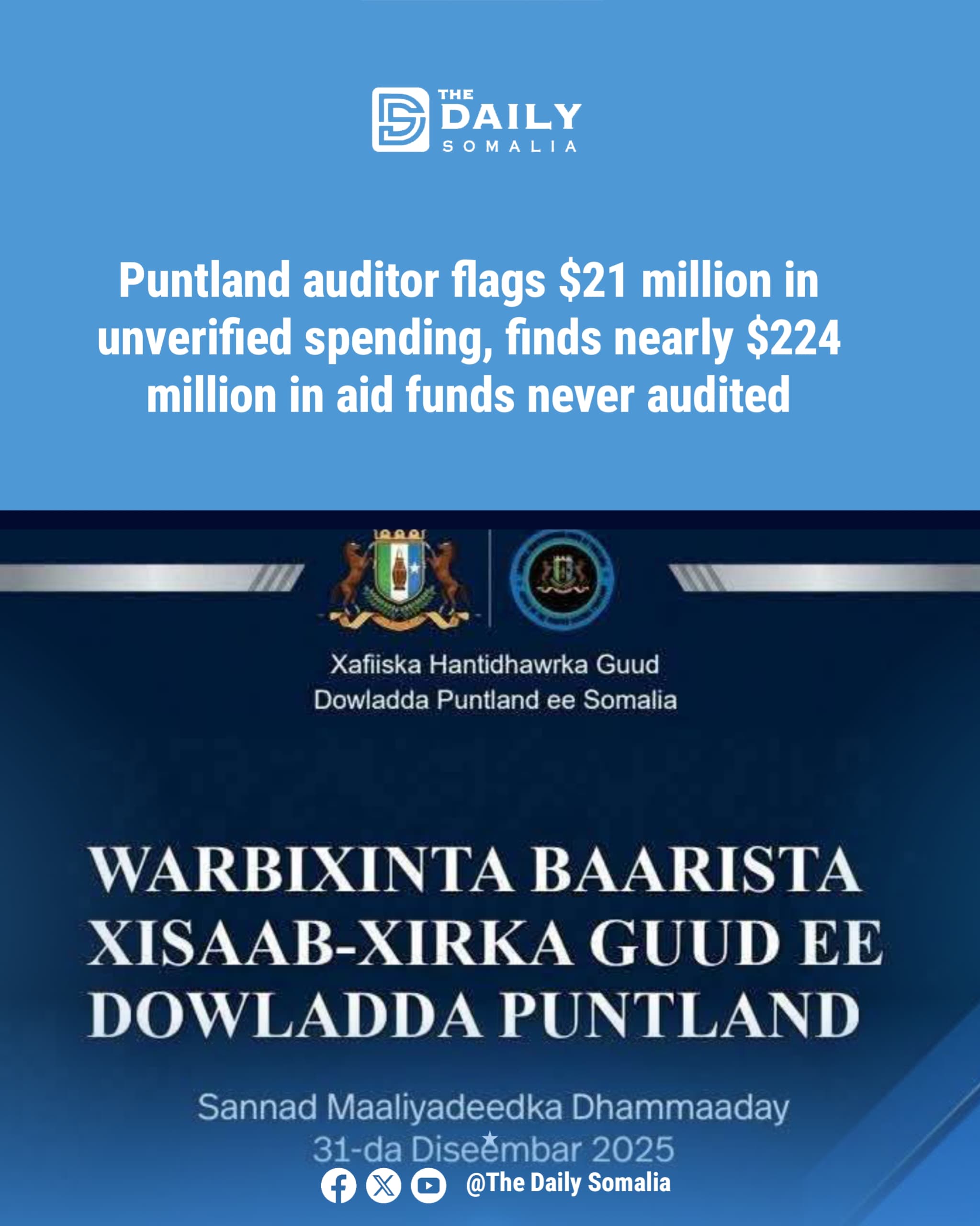
GAROWE, Puntland State, Somalia — Puntland’s Office of the Auditor General (OAG) has issued a qualified opinion on the state’s 2025 consolidated financial statements, citing $21.4 million in government spending it could not fully verify and disclosing that donor-funded projects worth close to a quarter of a billion dollars were never submitted for independent audit, according to a report released this week.
The findings, contained in the OAG’s annual audit of the Puntland government’s accounts for the year ended December 31, 2025, cover a budget the House of Representatives had approved at $466.8 million — but auditors say they were able to verify only about $195.6 million of that total, roughly 42%.
The single largest gap involves international non-governmental organizations. Auditors said $224.2 million earmarked in the 2025 budget for projects run by INGOs and local NGOs was never accounted for in the government’s books, with the report listing zero dollars in verified spending against that line.
A separate $79.3 million allocated to United Nations agencies fared only slightly better. The Accountant General’s office told auditors that eight U.N. agencies reported spending $67.7 million on projects in Puntland, but the OAG said it “did not receive the supporting financial accountability documentation, including audited financial statements,” and therefore could not audit the transactions itself.
“I remain fully committed to advancing public financial management in the Puntland State of Somalia,” Auditor General Osman Mohamud Ali wrote in the report, addressed to the Speaker of the House of Representatives under the office’s constitutional mandate.
Qualified opinion, twin findings
The audit’s qualified opinion — one notch below a clean “unqualified” rating on the four-tier scale used in public-sector auditing — rested on two findings within the government’s core treasury spending.
Auditors said $5.9 million in expenditure was recorded in the government’s financial system, known as PFMIS, as payable to the Puntland State Central Bank rather than to the actual recipients of the funds, a practice the report says breaches government policy requiring payments to name the real beneficiary.
A further $15.5 million in spending lacked adequate paperwork: $7.4 million was paid out with no requisition or payment request on file at all, and $8.2 million more was processed on incomplete requests missing required signatures and approvals. “I was unable to verify the occurrence, accuracy and purpose of these expenditures,” the report states.
Liabilities, wages and unpaid contractors
The audit also found the government’s books understated its own debts. Official liabilities were recorded at $16.4 million, but auditors said they uncovered additional unreported obligations owed to at least two construction firms and utility providers. Separately, the report says $12.3 million in wages owed to civil servants and security forces remained unpaid, on top of roughly $4.9 million owed to contracting firms including Kebarco Construction, Al-Bashid Construction and Dahabshiil Bank.
Revenue declines, unresolved recommendations
Regional revenue collection fell sharply in parts of the state, the audit found: down 61% in the Raascaseyr region, 11% in Mudug and 6% in Nugaal, compared with the previous year. Auditors also flagged cases where local governments budgeted for revenue that was never collected, and instances where cash sat uncounted for extended periods before being deposited.
Of 18 districts included in the 2025 budget, only 11 submitted financial statements for audit.
The report also found that six of eight recommendations issued after the 2024 audit had not been implemented at all, with two more only partially addressed — including a long-standing call to reconcile bank accounts regularly and to tighten procurement compliance. Auditors separately found $7.1 million in procurement transactions lacking bid evaluations or contract-award documentation.
The OAG noted that Puntland’s government is still operating under financial regulations issued in December 1961, more than six decades old, despite a 2023 public financial management law that calls for updated implementing rules.
The Ministry of Finance, in a foreword to the same report, said domestic revenue collection reached 99.9% of its 2025 target, and pointed to reforms at Bosaso port and new staff training as evidence of progress in revenue administration.