

The Rejection of Omar Artan Is Not Just an Entry Denial — It Is a Declaration That African Excellence Does Not Belong at Its Own World Cup
By Abdiweli Waberi | June 8, 2026
“Omar Artan is among Africa’s most respected referees and deserves the support of the entire football community. Denying him entry to the United States and preventing him from officiating scheduled matches harms not only him personally but also undermines football’s commitment to fairness, merit, and the spirit of fair play.” — Ciise Aden Abshir, Senior Advisor, Somalia’s Ministry of Youth and Sports.
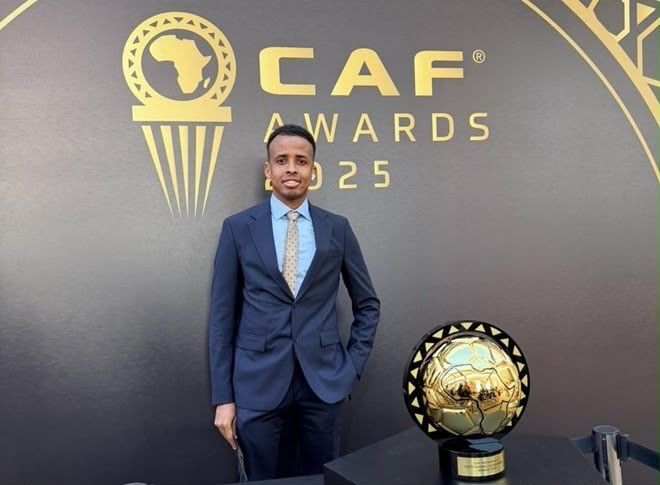
On the morning of June 8, 2026 — few days before the most-watched sporting event on the planet is due to open its curtain — Omar Abdulkadir Artan, CAF’s Best Male Referee of the Year 2025, one of only 52 match officials in the world selected by FIFA to officiate the 2026 FIFA World Cup, sat in Istanbul, Turkey. Not on a training pitch with his fellow referees, not preparing to make history as the first Somali referee ever to step onto a World Cup pitch. He was in Istanbul because the United States of America had turned him away.
He had a valid visa. He had a diplomatic passport, obtained with the extraordinary help of the Somali Embassy in Nairobi precisely because he had anticipated the obstacles a Somali passport would face. He had been approved by FIFA, after years of verified excellence. He had done everything right.And still, at Miami International Airport, US immigration authorities sent him back.
This piece of writing is not merely about a bureaucratic inconvenience. It is about what that moment at Miami airport represents: a systematic, politically motivated rejection of African excellence at the very tournament Africa helped make possible. It is about a pattern that the African football community — all nine African nations competing at this World Cup, all 54 member states of the African Union, and every institution that claims to stand for fairness in global sport — can no longer afford to treat as someone else’s problem.
Who Is Omar Artan? A Story Africa Should Know by Heart
Born in Mogadishu in 1992, Omar Artan came of age in a country where football itself was a complicated act of faith. Somalia’s footballing landscape had been devastated by decades of conflict and instability. Infrastructure was broken. Opportunities were scarce. Yet Artan found his passion in refereeing, working his way through local Somali leagues before earning his FIFA listing in 2018 — a feat that, in the context of his country, was extraordinary in its own right. It is perhaps fitting that Somalia’s greatest football contribution to the world has come not from a striker, but from the person the game entrusts to be fair.
In January 2024, he became the first Somali referee ever to officiate at the Africa Cup of Nations, presiding over Tunisia vs. Namibia and Algeria vs. Mauritania during the AFCON in Côte d’Ivoire — two matches that produced famous results for the underdogs. His composure under pressure was unmistakable. The refereeing community took notice.
By June 2025, Artan was standing at the summit of continental football, officiating the CAF Champions League final in Cairo between Egypt’s Pyramids FC and South Africa’s Mamelodi Sundowns — becoming the first Somali referee to take charge of an African continental final. Later that year, CAF made it official: Omar Abdulkadir Artan was Africa’s best referee of 2025.
In April 2026, FIFA announced its 52 referees for the 2026 World Cup. Omar Artan was among them — one of only seven African referees chosen, and the sole representative from Sub-Saharan Africa’s Horn region. He would have been the first Somali, in any capacity, to officiate a FIFA World Cup final tournament.
That was Africa’s story. A story of struggle, perseverance, excellence, and arrival on the world’s biggest stage.
Then America intervened.
The Chronology of a Rejection — How Every Door Was Slammed Shut
The path to Miami Airport was not a simple one. It was a journey that required extraordinary effort at every stage — and that is itself part of the indictment.
As the World Cup approached, Omar Artan began encountering obstacles obtaining the standard US entry visa. Other referees from around the world — Europe, South America, Asia — faced no such barriers. Artan’s Africanidentity, however, placed him in a category requiring additional scrutiny, additional paperwork, and additional uncertainty that his counterparts did not have to confront.
Recognising that Artan’s standard Somali passport would likely be insufficient to navigate US immigration’s treatment of Somali nationals, the Somali Embassy in Nairobi took the extraordinary step of facilitating a diplomatic passport for him. This was not a routine measure — diplomatic passports are reserved for officials whose travel carries official state weight. The fact that Somalia elevated a football referee to this status reflects how seriously the country took both his achievement and the obstacles in his path.
He travelled to Nairobi, transited through Istanbul, Turkey — and on June 8, 2026, he arrived at Miami International Airport, the gateway to one of the World Cup’s host cities. US immigration authorities denied him entry. No specific reason was communicated. He was not held pending for further review. He was not given an opportunity to present additional documentation or appeal to FIFA liaison officers. He was simply turned around and sent back to Istanbul. With a diplomatic passport, a valid US visa in hand and FIFA accreditation as one of 52 referees selected worldwide, Artan believed the hardest part was behind him. But unfortunately, the door of Miami International Airport still slams.
FIFA’s Silence Is the Loudest Sound in the Room
The same federation that spent years championing inclusion, diversity, and the growth of football in emerging nations — the same federation that invested in training programs for African referees and footballers precisely to build pathways like the one Artan walked — has offered no public intervention, no visible advocacy, and no loud declaration that one of their own selected officials must be present at their tournament.
FIFA’s silence here is not neutral. When an institution of its size and influence watches its appointed referee face a visa barrier and does not use every tool at its disposal to resolve it, that silence becomes complicity. The organization has diplomatic relationships, host country agreements, and the weight of an event that generates billions of dollars in revenue. The idea that it cannot secure the entry of its own carefully selected match officials — or that it would not try loudly and urgently — is impossible to accept without serious questions.
Artan’s case sits at the intersection of a broader, deliberate pattern of exclusion that the Trump administration has applied to the 2026 World Cup, in defiance of the spirit — and arguably the letter — of the hosting agreement FIFA signed with the United States.
Fans from Senegal and Ivory Coast — two of Africa’s finest football nations, both qualified for the World Cup — found their ability to travel to the United States effectively suspended after those countries were added to the travel ban list in December 2025. Supporters who had been planning for years to attend a World Cup on the same continent were suddenly barred. “I don’t know why the American president would want teams from certain countries not to take part. If that’s the case, they shouldn’t agree to host the World Cup,” said one Senegal supporter at the Africa Cup of Nations in Morocco.
And now, a referee. Not a fan. Not an official. Not a delegation member. But a FIFA-appointed, CAF-certified, diplomatically-documented match official, selected through the most rigorous independent merit process that world football operates.
The Call for Solidarity — What African Nations Must Do Now?
This is the moment that tests whether African solidarity exists beyond rhetoric. And the response must be collective, coordinated, and immediate. Morocco, Senegal, Egypt, Nigeria, Côte d’Ivoire, Cameroon, South Africa, Mali, and Algeria — every African nation competing at this World Cup — must formally raise the case of Omar Artan through their respective Football Federations, their governments’ diplomatic channels, and at the tournament itself. A joint statement from all nine African football federations, presented to FIFA, to the US State Department, and to the international media, would carry weight that any individual federation’s voice cannot. These nations did not travel to this World Cup as guests. They earned their places. They are participants, not spectators. And what happens to Omar Artan is a signal directed at all of them.
The Confederation of African Football awarded Omar Artan its highest refereeing honour. He carries CAF’s certification and CAF’s name into that World Cup. His exclusion is therefore not Somalia’s problem alone — it is CAF’s problem. CAF President Patrice Motsepe must issue an official, unambiguous statement demanding that the United States government provide an immediate and transparent explanation, and that FIFA facilitate Artan’s entry as a matter of urgency.
Finally, if the football world — FIFA, CAF, the African nations competing, the global football community — watches this happen in silence, then the next whistle blown at the 2026 FIFA World Cup will carry the weight of a question no one has answered: whose tournament is this, really?
Omar Artan earned his place. It is time the world ensures he is given it.
